

It’s rare to have the opportunity to be face-to-face—or rather, face-to-helmet—with a robot, while still being observed by it from a different perspective. That’s because the Linz-based company—Austria’s only manufacturer of humanoid robots—has incorporated an unusual feature into Workmate: a drone that can take off from and land back on the robot’s head, thereby expanding the robot’s field of view.
During a meeting with the founder of IONO Robotics, Salzburg native Ümit Bas, we discussed the technical details and intended uses of Workmate, the startup’s first humanoid model. Ümit is an engineer who has worked on transcription tools, smartwatches, and digital coffee makers, among other things, and has always been fascinated by the combination of hardware and software. In 2006, he tinkered with a robot vacuum cleaner, hoping to enable it to learn about its surroundings and build a world model, but the project ultimately failed due to a lack of computing power.
Just under twenty years later, the conditions were finally in place, and—inspired by Boston Dynamics—he discovered humanoid robots three years ago. In April 2025, Ümit founded his company. He is a solo founder more out of necessity than anything else, as he has not yet found any suitable co-founders.
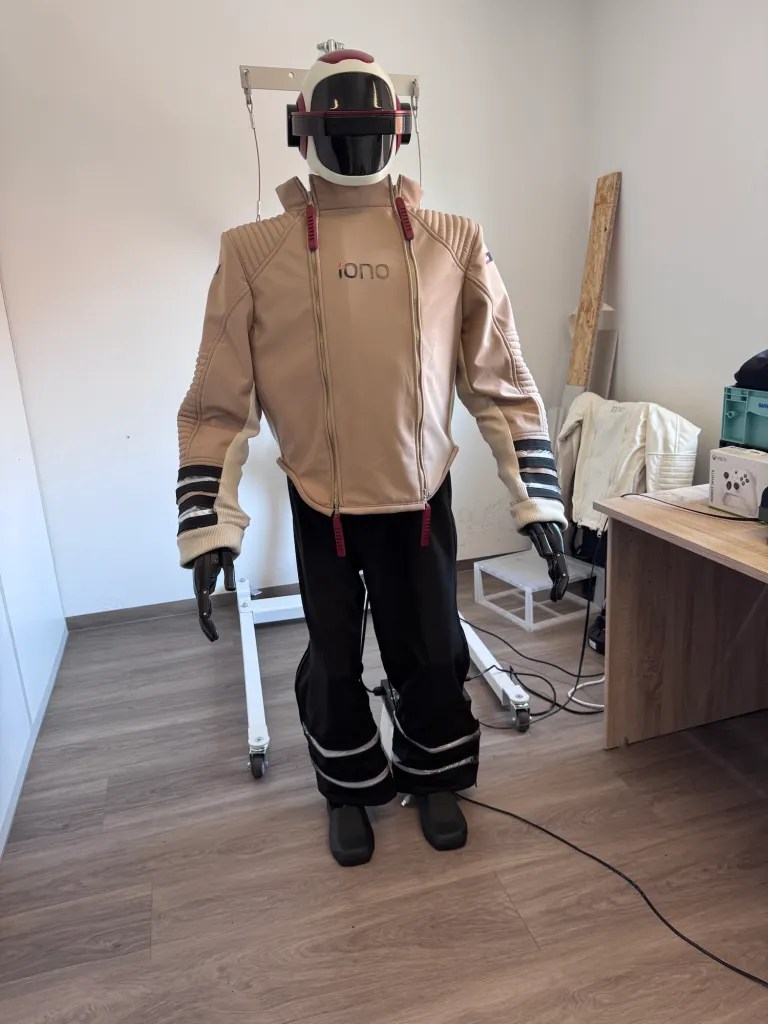
Workmate, the name of IONO Robotics’ first humanoid model, is about 175 centimeters tall, can carry up to 30 kilograms, is equipped with 20 sensors, and can move at a speed of about 5 km/h. It processes sensor data using an NVIDIA Jetson Orin computing unit. The software is based on ROS 2 and the proprietary IonoSphere platform, which was developed specifically for data security and EU compliance (GDPR). And, as mentioned earlier, a drone can take off and land from the IonoHead. Another unique feature is the clothing, which has sensors integrated into it. This so-called IONO Skin features active cooling and heating.
The robot can operate both bipedally—that is, on two legs—and on a wheeled platform. The company has developed its own platform for this purpose, into which the robot can climb and lock into place, allowing it to travel along the aisles in a factory or office.
Currently, some components still come from China, but the goal is to have the entire value chain and production based in Europe. The next important step for IONO Robotics is to refine the software.
The company sees applications for the Workmate industrial robot in manufacturing, logistics, and the service sector. The team is in talks with a large number of companies that have expressed interest in the humanoid robot for their own use cases, and the first deployments in industrial settings are set to begin this summer.
IONO Robotics has also released a highlight reel from the product launch in May 2026 featuring the unveiling of the humanoid robot.